✨ This article was AI edited. Editorial responsibility: Britany Marshall Beauty.
How to Clean and Disinfect Makeup Brushes at Home Without Ruining Bristles
Struggling with shedding bristles, misshapen brush heads, or wondering why your pristine skincare routine is being sabotaged by cystic cheek breakouts? In this master makeup artist sanitation manual, we deconstruct the glue chemistry inside metal ferrules, compare natural hair versus synthetic fiber wash mechanics, and give you the step-by-step clinical cleaning protocol that extends your tool lifespan by over a decade.
Contents of Article
- 30-Second Master Verdict: The Ferrule Preservation Rule
- Makeup Brush Cleanser & Fiber Compatibility Matrix
- 1. The Microbiology of a Dirty Brush: Why Your Tools Cause Mystery Breakouts
- 2. The Anatomy of a Brush: Why Upright Drying Destroys the Ferrule
- 3. The 4-Step Master Cleaning Blueprint: The Professional Protocol
- 4. Frequently Asked Questions: Makeup Brush Care & Hygiene
30-Second Master Verdict: The Ferrule Preservation Rule
The Golden Rule: Water is the ultimate enemy of a makeup brush when it reaches the metal ferrule. Never submerge brush handles in water, never use hot water, and never dry brushes standing upright in a cup. Water seeping into the ferrule dissolves the water-soluble epoxy resin holding the bristles together, causing chronic shedding and rot. Wash bristles pointing strictly downward at a 45-degree angle, cleanse with a sulfate-free conditioning soap on a textured silicone pad, reshape the head, and dry completely flat or angled downward using breathable mesh brush guards.
Makeup Brush Cleanser & Fiber Compatibility Matrix
1. The Microbiology of a Dirty Brush: Why Your Tools Cause Mystery Breakouts
When you apply liquid foundation or cream blush, your brush collects not just makeup pigment, but facial sebum, dead skin cells, environmental particulate matter, and the resident skin microbiome. When placed in a dark vanity drawer or warm bathroom cup, the interior core of a dense kabuki brush becomes a literal petri dish.
Independent microbiological swabs of regularly used, unwashed makeup brushes consistently isolate high colony counts of:
- Staphylococcus epidermidis & Staphylococcus aureus: Opportunistic pathogens that enter micro-fissures in the skin, causing painful pustules and folliculitis.
- Cutibacterium acnes: Rapidly proliferates within the trapped lipid squalene clinging to synthetic fibers, inoculating your pores with acne-triggering bacteria every single morning.
- Malassezia Yeast & Fungal Spores: The direct catalyst for “fungal acne” (pityrosporum folliculitis)—the stubborn, itchy, uniform red bumps that do not respond to traditional salicylic acid or benzoyl peroxide.
If you are investing hundreds of dollars in clinical serums while using a foundation brush unwashed for two weeks, you are actively wiping bacterial colonies across freshly exfoliated skin.
2. The Anatomy of a Brush: Why Upright Drying Destroys the Ferrule
A makeup brush consists of three anatomical components: the wooden handle, the metal ferrule (usually crimped brass or aluminum), and the bristle head. Inside the ferrule, thousands of individual hair fibers are bound together into a dense plug using a water-soluble industrial epoxy adhesive.
The classic error of standing wet brushes upright in a brush holder to dry creates a destructive gravitational siphon:
- Water flows downward inside the ferrule, pooling around the adhesive base plug.
- The water dissolves and softens the epoxy glue over 6 to 12 hours.
- The wooden handle inside the ferrule absorbs moisture, expands, and cracks the internal lacquer seal.
- Once dry, the wood contracts, leaving the ferrule loose and wobbly, while individual bristles begin shedding in clumps across your face during makeup application.
3. The 4-Step Master Cleaning Blueprint: The Professional Protocol
Step 1: Wet Bristles Angling Downward at 45 Degrees
Adjust your tap to lukewarm (never hot) water. Extreme hot water weakens synthetic fibers and melts heat-sensitive glues.
- Hold the brush firmly by the handle, keeping the bristles pointed downward at all times.
- Let lukewarm water stream over the hair fibers only, stopping at least 1/2 inch below the metal ferrule seam.
- Never submerge the brush head completely underwater in a cup or bowl.
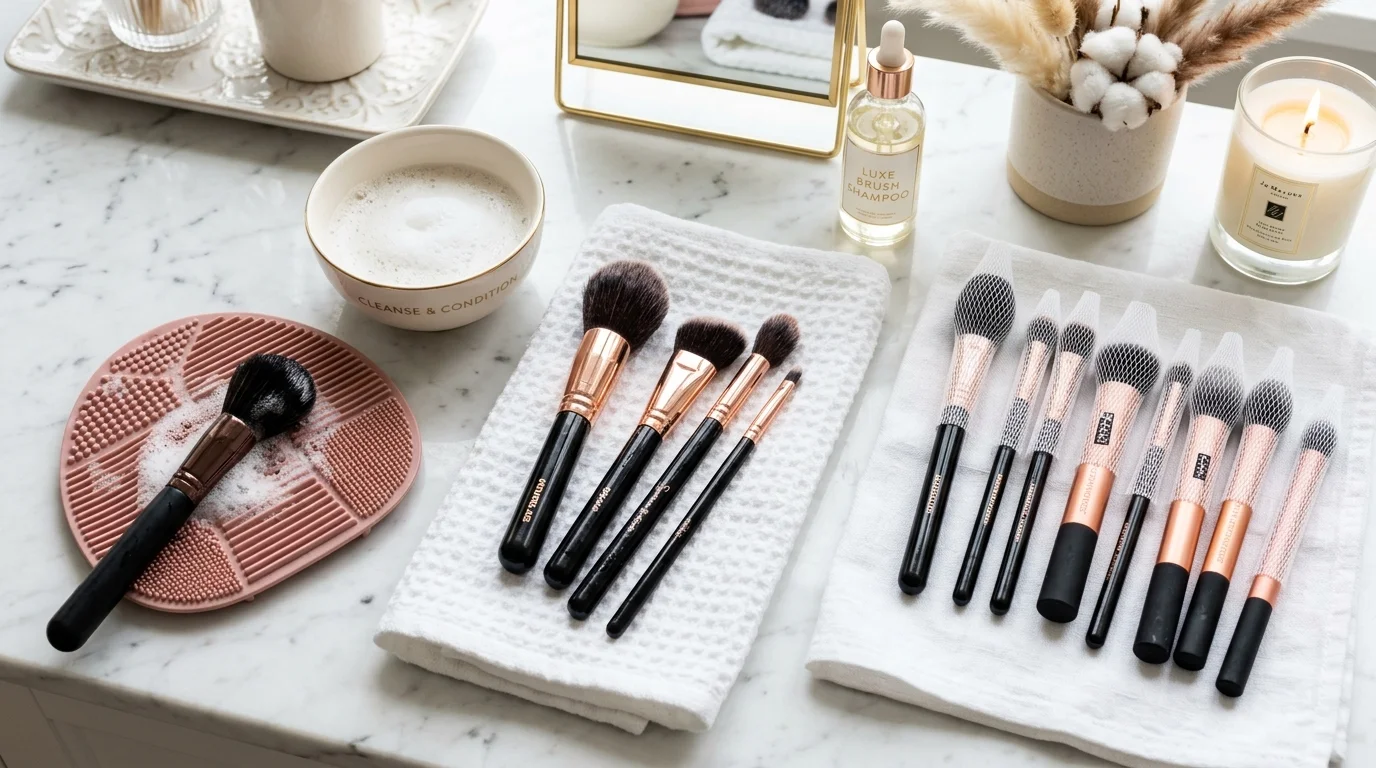
Step 2: Swirl on a Textured Silicone Mat with Conditioning Cleanser
Hands alone cannot reach the dense central core of foundation and powder brushes.
- Apply a pea-sized amount of specialized solid brush cleanser or liquid castile soap mixed with a drop of fractionated olive oil onto a textured silicone cleaning pad.
- Gently swirl the wet brush head in circular motions against the textured ridges. The silicone grooves flex the fibers, dislodging trapped silicone, pigment, and sebum from the deepest layers.
- For delicate natural goat or squirrel hair, use gentle sweeping back-and-forth motions rather than aggressive circular grinding to preserve outer cuticles.
Step 3: Rinse Until Water Runs Crystal Clear
Residual soap scum left in bristles acts like a magnet for airborne dust and causes chalky makeup patchiness.
- Holding the brush pointed downward under the lukewarm water stream, gently cup the bristles with your fingers to rinse away all soapy lather.
- Repeat until the runoff water transitions from milky beige to 100% transparent.
- Gently squeeze excess water out by sliding your thumb and index finger from the base of the bristles to the tips. Never wring, twist, or yank the fibers.
Step 4: Reshape Bristles & Dry Inverted (Gravity Drainage)
How a brush dries dictates its permanent physical shape and structural longevity.
- Using a clean, dry microfiber cloth, gently pat the bristles dry and reshape the head into its original dome or angle.
- Slip an expandable mesh brush guard over the handle and up over the bristles. The mesh compresses the bristles tightly, preventing “frizz” and splaying as water evaporates.
- Lay brushes flat on a clean dry towel with the brush heads hanging off the edge of a counter, or roll one end of the towel to create a 30-degree downward tilt so gravity pulls any residual moisture away from the ferrule.
- Allow to air-dry in a well-ventilated room for 8 to 12 hours. Never use a hairdryer, as heat warps synthetic polymers and scorches natural hair.
4. Frequently Asked Questions: Makeup Brush Care & Hygiene
How often should you deep clean your makeup brushes?
Brushes used for liquid or cream formulas (foundation, concealer, liquid contour) should be deep-cleaned once every 7 days because liquid emulsions foster rapid bacterial proliferation. Brushes used strictly for dry powder products (bronzer, setting powder, eyeshadow) can be deep-cleaned every 10 to 14 days, with quick-dry alcohol spot cleaning in between.
Can I use micellar water to clean my brushes?
Micellar water is fantastic for quick surface spot cleaning on synthetic eye and lip brushes. However, micellar surfactants leave an invisible hydrophilic conditioning film on dense foundation brushes that can attract dirt quickly. For a true deep clean, follow micellar water with a quick rinse in clear water.
Does rubbing alcohol (70% isopropanol) disinfect makeup brushes?
Yes, 70% isopropanol kills 99.9% of bacteria within 30 seconds of contact. It is safe for synthetic bristles (Taklon, PBT nylon). However, frequent alcohol application will strip the natural cuticle layer of animal hair brushes (goat, squirrel, sable), making them brittle, scratchy, and prone to breaking. For natural hair, stick to gentle conditioning solid soaps.
How do I fix a makeup brush that has splayed out and lost its shape?
Wash the brush thoroughly, squeeze out excess moisture, and work a tiny droplet of aloe vera gel or hair styling mousse through the damp bristles. Shape the head into its original perfect contour, slide a tight mesh brush guard over it, and let it dry for 24 hours. The styling hold will train the fibers back into position without leaving greasy residue.
Editorial & Trademark Transparency: All product names, logos, salon equipment specifications, and registered trademarks mentioned within this educational guide are property of their respective owners. Mention of brush fiber structures, ferrule adhesives, and chemical cleansing agents is conducted strictly under fair use for consumer education, hygiene safety, and comparative beauty analysis. Britany Marshall Beauty is an independent digital publication.
Get our latest guides, news, and insights highlighted in your Google Search & AI Overviews.