✨ This article was AI edited. Editorial responsibility: Britany Marshall Beauty.
How to Layer Vitamin C, Hyaluronic Acid, and Retinol: The Complete Application Order Guide
Struggling with pilling, tingling irritation, or questioning why your expensive serums aren’t producing radiant results? In this dermatological sequencing protocol, we deconstruct the exact molecular physics, chemical pH windows, and circadian rhythms required to layer L-ascorbic acid, multi-weight hyaluronic acid, and vitamin A without deactivating their active bonds or compromising your lipid barrier.
Contents of Article
- 30-Second Clinical Verdict: The Circadian Split Principle
- Active Ingredient Compatibility & Molecular Mechanics Matrix
- 1. The Molecular Physics of Skincare Layering: Beyond the “Thin-to-Thick” Myth
- 2. The Golden AM Protocol: Antioxidant Photoprotection & Moisture Priming
- 3. The Golden PM Protocol: Cellular Turnover & Fibroblast Reconstruction
- 4. The Actives Conflict Red List: Combinations to Never Layer Simultaneously
- 5. Frequently Asked Questions: Active Ingredient Layering
30-Second Clinical Verdict: The Circadian Split Principle
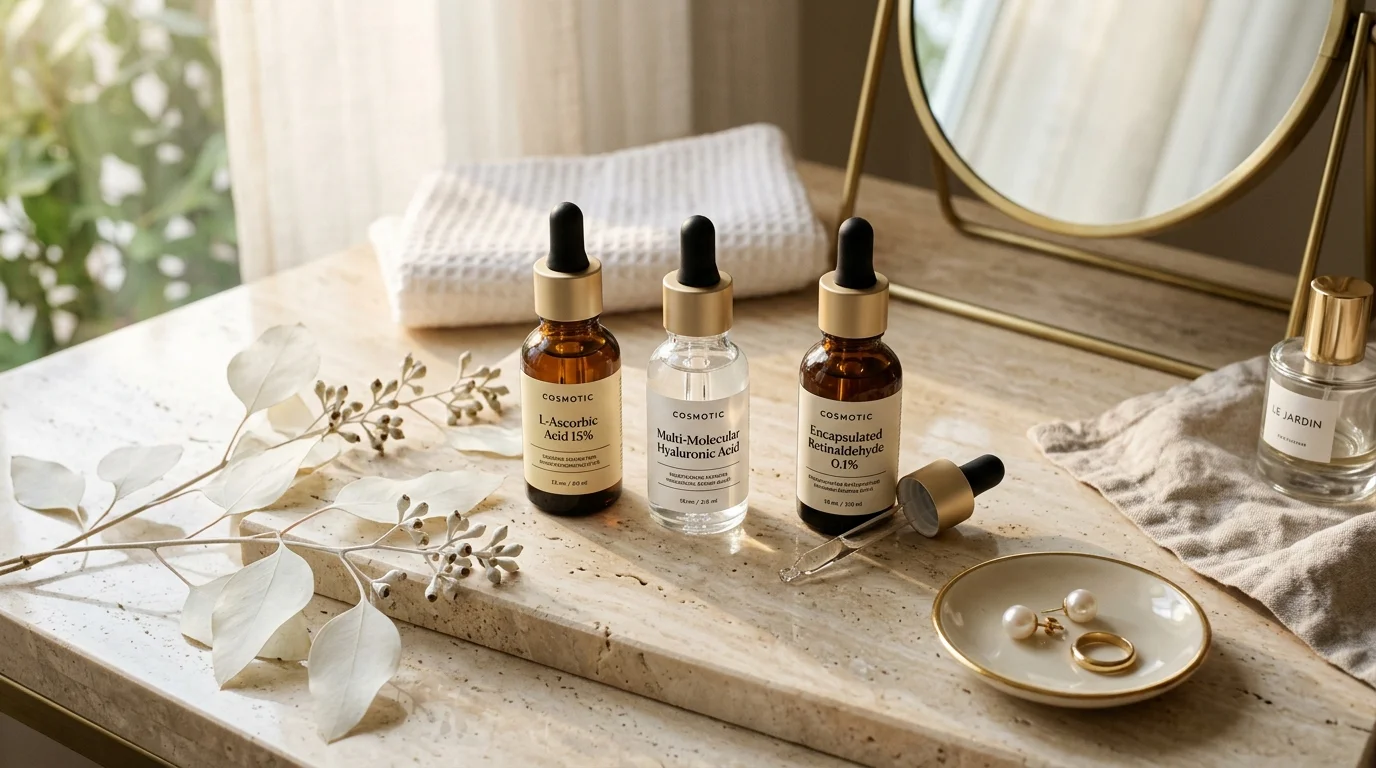
The Golden Rule: Never mix pure L-ascorbic acid (Vitamin C) and Retinol in the same simultaneous application. L-ascorbic acid requires an acidic pH window of <3.5 to penetrate, whereas retinoids require a neutral pH of 5.5–6.5 and degrade rapidly in direct UV light. Deploy Vitamin C in the morning on bare skin beneath hyaluronic acid and broad-spectrum SPF 50+ for antioxidant photoprotection. Reserve Retinol for the evening on completely dry skin (or sandwiched between ceramide layers) to stimulate nocturnal fibroblast collagen synthesis without retinoid dermatitis.
Active Ingredient Compatibility & Molecular Mechanics Matrix
1. The Molecular Physics of Skincare Layering: Beyond the “Thin-to-Thick” Myth
The classic internet skincare advice to “apply products from thinnest to thickest consistency” is a helpful rule of thumb for casual routines, but when dealing with high-potency clinical actives, it is biochemically insufficient. Effective penetration without irritation is governed by three rigorous scientific variables:
- Chemical pH Windows and Acid Dissociation (pKa): Human skin maintains an acidic surface “acid mantle” ranging between pH 4.7 and 5.5. Pure L-ascorbic acid possesses a pKa of 4.2 and must be formulated at a pH below 3.5 to remain in an un-ionized, lipid-soluble state capable of diffusing across the stratum corneum. If you apply a neutral pH product (such as a basic hydrating toner or moisturizer) immediately before your Vitamin C, the surface pH elevates, ionizing the ascorbic acid molecules and drastically reducing dermal absorption.
- Molecular Size and Dalton Cutoff: The human stratum corneum is impermeable to compounds exceeding 500 Daltons (the 500-Dalton Rule). L-ascorbic acid (176 Daltons) easily penetrates. Hyaluronic acid, however, ranges from High Molecular Weight (1,000 to 1,800 kDa), which remains on the surface to prevent moisture evaporation, down to Ultra-Low Molecular Weight (3 to 10 kDa), which sinks deeper into the epidermis. Layering high-molecular polymers before small active molecules creates an impenetrable polymeric film that causes subsequent serums to pill and roll off.
- Solvent Polarity (Water vs. Lipid Partitioning): Hydrophilic (water-based) serums must precede lipophilic (oil-based) creams. Applying a lipid-rich oil or dense wax before an aqueous vitamin C serum completely blocks the water-soluble ascorbic acid from ever reaching epidermal receptors.
2. The Golden AM Protocol: Antioxidant Photoprotection & Moisture Priming
During daylight hours, ultraviolet radiation (UVA and UVB) and atmospheric pollutants generate high cascades of reactive oxygen species (ROS) that break down collagen fibrils and activate melanocytes. Your morning routine is dedicated entirely to defense.
AM Step-by-Step Chronological Execution:
- Step 1: Gentle Cleanser (pH 5.5): Cleanse with a mild, non-foaming surfactant gel or simply splash with lukewarm water if dry. Pat skin until nearly dry.
- Step 2: L-Ascorbic Acid (Vitamin C 15% + E + Ferulic): Apply 4–5 drops directly to dry skin. The low pH formula requires unbuffered contact with the stratum corneum. Allow a 2–3 minute dwell window for the acid mantle to absorb the antioxidant reservoir before introducing neutral pH hydration.
- Step 3: Hyaluronic Acid Serum (On Lightly Misted Skin): Lightly mist with pure thermal water or pat with damp fingertips, then immediately apply multi-molecular hyaluronic acid. HA functions as a molecular sponge: if applied to bone-dry skin in low humidity, it can pull water outward from the dermis. Providing moisture allows it to plump the superficial epidermis.
- Step 4: Ceramide Barrier Moisturizer: Seal in the humectant moisture with a physiological lipid cream formulated with ceramides, cholesterol, and free fatty acids to prevent trans-epidermal water loss.
- Step 5: Broad-Spectrum SPF 50+: The non-negotiable anchor. Vitamin C and chemical/mineral UV filters operate synergistically: Vitamin C quenches free radicals that penetrate physical sunscreen filters, doubling photoprotection against photoaging.
3. The Golden PM Protocol: Cellular Turnover & Fibroblast Reconstruction
At night, trans-epidermal water loss accelerates, cutaneous microcirculation increases, and cellular mitosis reaches its peak. This is the physiological window for retinoic acid receptor activation.
PM Step-by-Step Chronological Execution:
- Step 1: Double Cleansing: First, melt waterproof SPF and sebum with a plant-derived cleansing balm or squalane oil. Follow with a gentle amino-acid water-based cleanser to eliminate surfactants.
- Step 2: Hyaluronic Acid or Hydrating Toner: Apply your hydrating humectant immediately to damp skin to re-establish hydration baseline.
- Step 3: The 5-Minute Dry-Down Quarantine: Crucial step! Wait until your face is completely, 100% dry to the touch. Applying retinoids to damp skin dramatically accelerates penetration speed, overwhelming retinoid receptors and triggering acute erythema, peeling, and contact dermatitis.
- Step 4: Retinol or Retinaldehyde (Pea-Sized Amount): Smooth a single pea-sized drop across the forehead, cheeks, and chin. Avoid the sensitive periorbital bone and corners of the lips.
- Step 5 (Optional – The Sandwich Method for Sensitive Skin): If your skin is sensitive or prone to flaking: apply a thin layer of ceramide moisturizer → wait 5 minutes → apply retinol → wait 5 minutes → apply a second layer of ceramide moisturizer. Clinical trials prove the Sandwich Method reduces retinoid dermatitis by over 60% without blunting long-term collagen stimulation.
- Step 6: Rich Barrier Restorative Cream: Finish with a nourishing lipid cream fortified with squalane, panthenol, and madecassoside to prevent nocturnal water evaporation.
4. The Actives Conflict Red List: Combinations to Never Layer Simultaneously
Mixing incompatible active ingredients does not just reduce their efficacy—it causes severe barrier compromise and contact dermatitis:
- Retinol + Benzoyl Peroxide: Benzoyl peroxide is a potent oxidizing agent designed to kill C. acnes bacteria. Retinol is a sensitive, easily oxidized polyprenoid molecule. When applied together, benzoyl peroxide immediately oxidizes and degrades the retinol, rendering both compounds biologically inactive while leaving behind inflammatory byproducts.
- L-Ascorbic Acid + Copper Peptides (GHK-Cu): Copper acts as a catalyst that accelerates the oxidation of ascorbic acid into dehydroascorbic acid, turning both serums orange-brown. Simultaneously, the low pH of the Vitamin C alters the chelation of the copper peptide, destabilizing its wound-healing benefits.
- Retinol + Glycolic/Salicylic Acid in the Same Session: While chemical exfoliants (AHAs/BHAs) and retinoids both enhance cellular turnover, they work through entirely different mechanisms. Combining them in a single evening routine chemically dissolves intercellular desmosomes while accelerating cell division, causing catastrophic stratum corneum barrier collapse. Alternate them on different nights (e.g., Skin Cycling: Exfoliation Night → Retinoid Night → Recovery Night → Recovery Night).
5. Frequently Asked Questions: Active Ingredient Layering
Can I use Vitamin C and Niacinamide together?
Yes. The historic fear that Vitamin C and Niacinamide react to form nicotinic acid (causing flushing) stems from a 1960s study conducted at unphysiologically high temperatures and extreme acid environments. In modern, stable cosmetic formulations at room temperature, Vitamin C and Niacinamide are completely compatible and provide complementary brightening by targeting melanogenesis at two distinct biological checkpoints.
Should Hyaluronic Acid go on wet skin or dry skin?
Always apply hyaluronic acid on damp or lightly misted skin. Because sodium hyaluronate is a powerful humectant, it binds to external surface moisture and carries it into the upper layers of the epidermis. If applied onto bone-dry skin in an arid or air-conditioned environment, it will draw moisture outward from deeper dermis layers, paradoxically worsening dehydration.
How long do I need to wait between applying Vitamin C and Hyaluronic Acid?
A brief 2 to 3-minute dwell time is optimal. This allows pure L-ascorbic acid to interact with the acidic mantle and initiate cellular absorption. You do not need to wait 20–30 minutes as suggested by older internet lore; once the serum is absorbed and skin feels dry to the touch, you can mist and apply your hyaluronic acid.
What should I do if my skin starts burning after layering actives?
Immediately rinse your face with cool, lukewarm water to dilute the actives. Avoid foaming cleansers. Immediately apply a soothing barrier cream rich in panthenol (Vitamin B5), colloidal oatmeal, and ceramides. Cease all active acids and retinoids for 5 to 7 days, maintaining a strict recovery routine of gentle cleanser, barrier cream, and mineral sunscreen until neurosensory stinging fully subsides.
Editorial & Trademark Transparency: All product names, logos, clinical brand references, and registered trademarks mentioned within this educational guide are property of their respective owners. Mention of INCI formulations, chemical structures, and comparative methodologies is conducted strictly under fair use for consumer education, safety triage, and scientific comparative analysis. Britany Marshall Beauty is an independent digital publication.
Get our latest guides, news, and insights highlighted in your Google Search & AI Overviews.