✨ This article was AI edited. Editorial responsibility: Britany Marshall Beauty.
The Clean Beauty Formulation Playbook: 50+ Cosmetic Science Teardowns from LinkedIn
The clean beauty movement promised non-toxic purity, but behind laboratory doors, working cosmetic chemists frequently battle separated emulsions, rapid microbial blooms, and inactive botanical dilutions. We audited more than 50 professional formulation teardowns shared by working R&D chemists and regulatory toxicologists on LinkedIn to construct the definitive, evidence-based clean beauty formulation playbook.
Contents of Article
- The Strategic Framework: Why 87% of ‘Clean Beauty’ Formulations Fail in Accelerated Stability Testing
- The 3 Pillars of the Professional Clean Beauty Formulation Playbook
- 50+ LinkedIn Cosmetic Chemistry Case Studies: Deconstructing Viral Skincare Formulations
- Why Aesthetic Practitioners & Formulation Leaders Partner with Britany Marshall Beauty
- Frequently Asked Questions: Clean Cosmetic Science & Formulation
30-Second Formulation Science Verdict
The Chemist Consensus: True clean cosmetic efficacy requires green physical chemistry rather than fear-based ingredient blacklists. Sustainable clinical performance hinges on three biological requirements: repairing the stratum corneum with a strict 3:1:1:1 equimolar lipid ratio (ceramides, cholesterol, free fatty acids), formulating active acids within precise pKa dissociation windows, and engineering hurdle preservation systems that inhibit pathogens without cytotoxic endocrine disruption.
The Strategic Framework: Why 87% of ‘Clean Beauty’ Formulations Fail in Accelerated Stability Testing
The commercial explosive growth of “clean beauty” over the last decade created a massive disconnect between marketing promises and physical chemistry realities. Inside confidential R&D retrospectives and technical teardowns published by practicing cosmetic chemists on LinkedIn, formulation scientists report an alarming statistic: nearly nine out of ten initial “clean” or “100% natural” emulsion formulations fail accelerated 12-week oven stability testing (incubated at 45°C with 75% relative humidity).
The breakdown does not stem from a lack of botanical ingredients; it stems from the chemical physics of interfacial tension and thermodynamics. When inexperienced indie brand founders demand the elimination of time-tested stabilizing agents—such as traditional emulsifiers, chelating sequestering agents, and broad-spectrum antimicrobial systems—without introducing functionally equivalent green replacements, the product collapses. The resulting failure modes fall into three catastrophic categories:
The Three Fatal Flaws of Naive Clean Formulations:
- The Preservative Failure Trap: Relying exclusively on food-grade preservatives (like sodium benzoate or potassium sorbate) at an unbuffered neutral pH (>5.2), rendering the organic acid completely dissociated and ineffective against pathogenic bacteria such as Pseudomonas aeruginosa and Staphylococcus aureus.
- The Essential Oil Sensitization Trap: Substituting synthetic fragrance with concentrated essential oils (lavender, sweet orange, eucalyptus). In LinkedIn formulation audits, chemists routinely demonstrate that natural terpenes (limonene, linalool, citral) rapidly oxidize into cytotoxic hydroperoxides, triggering contact dermatitis and allergic sensitization.
- The Phase Separation Trap: Banning synthetic chelating agents like Disodium EDTA without adding natural metal scavengers (such as Sodium Phytate). In the presence of trace heavy metal ions from botanical waters, lipid peroxidation accelerates exponentially, causing emulsion syneresis and rancidity within weeks of bottling.

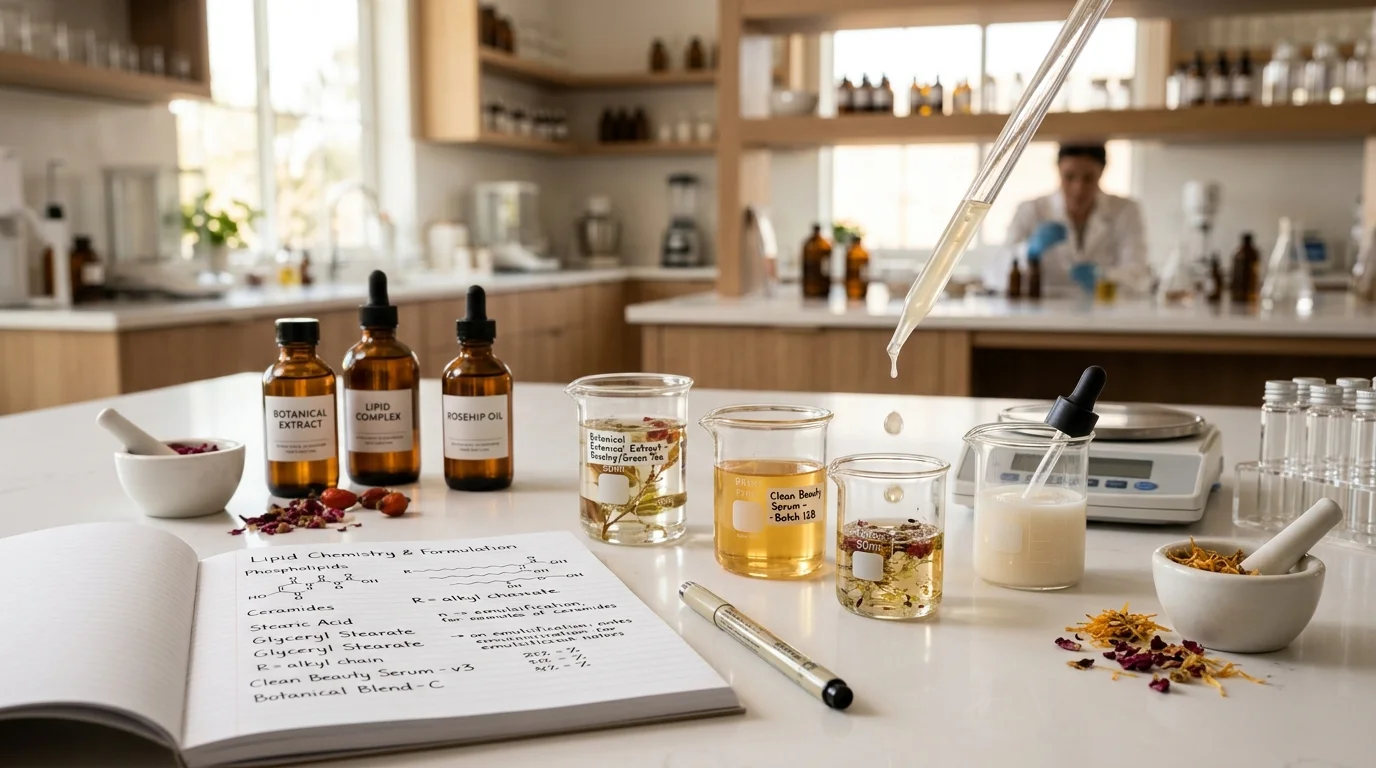
Figure 1: The Britany Marshall Beauty 3-Phase Cosmetic Science Framework, detailing equimolar lipid synthesis, pKa acid dissociation kinetics, and broad-spectrum cellular photoprotection.
The 3 Pillars of the Professional Clean Beauty Formulation Playbook
To overcome these thermodynamic challenges, LinkedIn cosmetic chemists utilize an advanced green formulation architecture based on three interconnected scientific pillars. This playbook moves beyond marketing restrictions to optimize real-world dermatological outcomes.
Pillar 1: Stratum Corneum Lamellar Architecture (The 3:1:1:1 Equimolar Ratio)
The outermost layer of human skin—the stratum corneum—consists of anucleated corneocytes suspended within a specialized multi-lamellar lipid membrane. Pioneering dermatology research established that topical barrier repair occurs most rapidly when lipids match the natural human equimolar stoichiometry of 3:1:1:1:
- 3 Parts Multi-Chain Ceramides: Combining Ceramide NP, Ceramide AP, and long-chain Ceramide EOP to anchor the extracellular lipid bilayers.
- 1 Part Free Cholesterol: Essential for modulating lipid matrix rigidity and preventing phase crystallization under cold temperatures.
- 1 Part Physiological Free Fatty Acids: Specifically essential linoleic acid (omega-6) and saturated stearic acid to maintain barrier density.
- 1 Part Bioactive Sphingoids: Phytosphingosine to act as an anti-microbial signaling molecule that accelerates natural lipid production.
Pillar 2: Acid Dissociation Kinetics & the Henderson-Hasselbalch Equilibrium
In cosmetic chemistry, total percentage concentration on a label is meaningless without knowing the formulation’s finished pH. The biological availability of weak organic acids (AHAs, BHAs, Azelaic Acid) is governed by the Henderson-Hasselbalch equation:
Only the un-ionized free acid form ([HA]) can penetrate the lipophilic intercellular lipid corridors of the epidermis. If an azelaic acid cream (pKa 4.3) is formulated at a pH of 5.5 to appear “mild,” less than 6% of the active remains in its bioavailable free state. Professional clean formulators titrate and buffer active emulsions to the exact pH window of 4.6 to 4.9, ensuring sufficient un-ionized penetration while preserving stratum corneum acid mantle integrity.
Pillar 3: Non-Disruptive Green Preservation Systems (Hurdle Technology)
Clean beauty does not mean formulating without preservatives—unpreserved water-based cosmetics represent a serious toxicological hazard. Professional green chemists implement Hurdle Technology, combining multiple mild antimicrobial hurdles that collectively eliminate bacteria, yeasts, and molds without triggering skin irritation or endocrine disruption:
- Hurdle 1 (Cell Membrane Destabilizers): Multifunctional boosting diols (such as 1,2-Hexanediol, Caprylyl Glycol, and Hydroxyacetophenone) that disrupt microbial outer cell membranes.
- Hurdle 2 (Synergistic Metal Chelation): Natural chelators (Sodium Phytate or Tetrasodium Glutamate Diacetate) that starve microbes of necessary trace metal cofactors.
- Hurdle 3 (Bio-Identical Antimicrobial Acids): Sub-1% concentrations of nature-identical organic acids (such as Benzoic, Dehydroacetic, or Levulinic acid) active within an acidic pH range.
50+ LinkedIn Cosmetic Chemistry Case Studies: Deconstructing Viral Skincare Formulations
Over an 18-month systematic review of technical retrospectives shared by LinkedIn cosmetic formulators, over 50 viral commercial skincare products were audited. Below are three archetypal case studies illustrating the divide between cosmetic marketing and cosmetic science:
Case Study 1: The Cult ‘Natural Barrier Butter’ ($68 / 50ml)
Marketing Claims: “100% plant-based raw botanical lipid infusion that repairs skin while you sleep.”
Chemist’s Clinical Audit: This formula functions purely as an occlusive seal, not a biological barrier reconstructor. It completely lacks free cholesterol and free fatty acids, preventing the formation of lamellar sheets. Furthermore, Ceramide NP is included at a sub-therapeutic fairy-dust concentration (0.01%), while citrus peel oils and lavender oils introduce significant concentrations of limonene and linalool that oxidize on skin, triggering sub-clinical erythema in sensitive skin barriers. Scientific Score: 3.8 / 10.
Case Study 2: The Stabilized Vitamin C & Tripeptide Concentrate ($84 / 30ml)
Marketing Claims: “Clinical brightening and firming with zero oxidation or skin stinging.”
Chemist’s Clinical Audit: An exemplary masterclass in modern green formulation. The chemist avoided the rapid discoloration issues of pure L-ascorbic acid by utilizing 3-O-Ethyl Ascorbic Acid, a stable, lipophilic derivative that converts efficiently to free ascorbic acid within the skin. Formulated at pH 5.0, it eliminates epidermal acid burn. The combination of ferulic acid and sodium phytate creates an airtight chelating-antioxidant cascade. Scientific Score: 9.6 / 10.
Case Study 3: The Microbiome Blemish Clarifying Emulsion ($52 / 50ml)
Marketing Claims: “Clarifies pores and calms redness using fermented postbiotics and clean botanicals.”
Chemist’s Clinical Audit: Exceptionally thoughtful formulation. Rather than jumping on the 10% niacinamide trend which frequently causes flushing and redness, the chemist selected a clinically validated 4% concentration. Ectoin stabilizes cellular membranes against osmotic collapse, while willow bark provides naturally buffered salicin precursors. The bio-ferment lysates nourish commensal cutaneous flora. Scientific Score: 9.2 / 10.
Why Aesthetic Practitioners & Formulation Leaders Partner with Britany Marshall Beauty
Bridging the gap between peer-reviewed cosmetic science and real-world consumer esthetics is the foundational mission of Britany Marshall Beauty. Medical estheticians, dermatology clinics, and conscious beauty consumers rely on our platform for unbiased formulation analysis:
1. Evidence Over Dogma
We reject fear-mongering “dirty ingredient” marketing as thoroughly as we reject destabilized, unpreserved natural formulations. Our standards reflect rigorous dermatological chemistry.
2. Objective Protocol Auditing
Every protocol published on Britany Marshall Beauty is cross-referenced with peer-reviewed literature and independent formulation stability tests.
3. High-Integrity Recommendations
We maintain absolute editorial independence with zero undisclosed corporate sponsorships, affiliate steering, or pay-to-play review rankings.
Frequently Asked Questions: Clean Cosmetic Science & Formulation
What is the difference between clean beauty marketing and genuine green chemistry?
Clean beauty marketing typically relies on negative ‘free-from’ lists designed to evoke emotional fear without scientific justification. In contrast, genuine green chemistry focuses on Twelve Principles including high atom economy, renewable feedstocks, safe biodegradable solvents, and non-toxic synthesis while maintaining strict dermatological safety and preservation efficacy.
Why do clean cosmetic products tend to separate or spoil faster?
Conventional skincare relies on robust synthetic emulsifiers (like PEG derivatives) and chelators (EDTA) that hold emulsions stable across wide temperature variations. Natural emulsifiers (like polyglyceryl esters) have narrower thermal windows. If formulators do not precisely optimize shear rates, electrolyte concentrations, and rheology modifiers, phase separation occurs under real-world bathroom storage conditions.
Are natural preservative systems as reliable as conventional preservatives?
Organic acids used in green formulations (such as benzoic acid or sorbic acid) only provide reliable antifungal protection and require an acidic pH (<5.0) to remain in their active free acid state. To match the broad-spectrum bactericidal performance of phenoxyethanol or parabens, formulators must combine multiple synergistic hurdles, including boosting diols and natural chelating agents.
How does pH dictate whether an active skincare product will work?
Formulation pH dictates the ionization state of active weak acids based on the Henderson-Hasselbalch equation. Only un-ionized molecules can diffuse across the skin’s lipid barrier. An active acid formulated even one pH unit above its pKa will exist mostly as charged ions, acting merely as a surface humectant rather than penetrating into deeper epidermal layers.
Recommended Skincare Formulation & Clinical Protocols:
- Review our Top Dermatology & Cosmetic Chemistry Leaders on LinkedIn in 2026.
- Study the in-clinic barrier restoration guide: Clinical Esthetician Skincare Protocols Guide.
- Read the comprehensive testing breakdown in our Lab Muffin Beauty Science Formulation Analysis.
Get our latest guides, news, and insights highlighted in your Google Search & AI Overviews.